The story
From insulin discovery to peptide synthesis
Insulin research helped scientists learn how to determine the order of amino acids in a protein. Around the same time, chemists learned to build short amino acid chains. These four Nobel Prize milestones trace the development of both techniques.
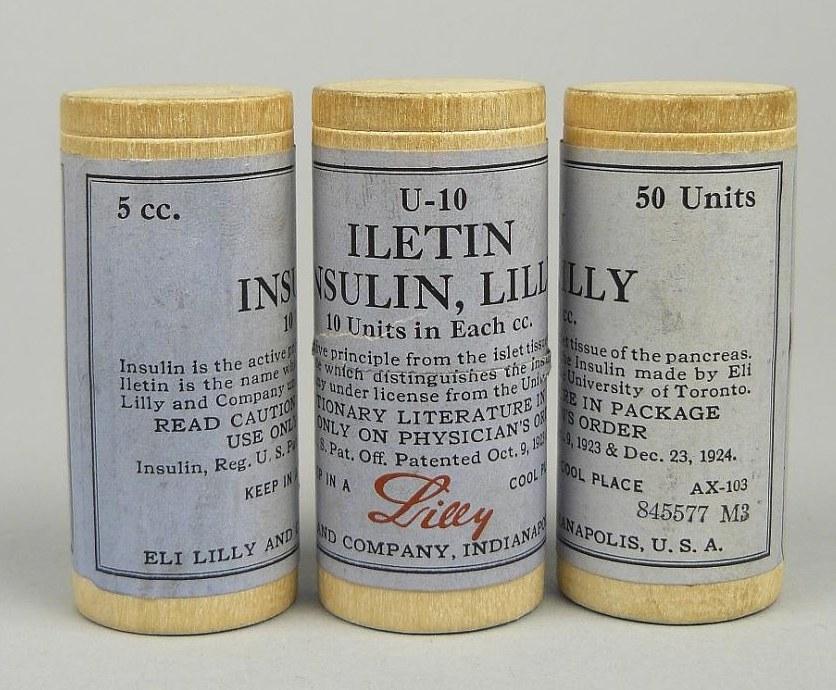
- 1923
A team discovers insulin
Frederick Banting and Charles Best carried out early experiments in John Macleod’s laboratory. James Collip helped purify the insulin extract for clinical use.
Science History Institute’s account of the insulin team
The Nobel Prize in Physiology or Medicine was awarded jointly to Frederick Grant Banting and John James Rickard Macleod for the discovery of insulin.
- 1955
A team makes oxytocin
Vincent du Vigneaud’s team synthesized oxytocin, a hormone made up of nine amino acids.
The Nobel Prize in Chemistry was awarded to Vincent du Vigneaud for his work on biochemically important sulphur compounds, especially for the first synthesis of a polypeptide hormone.
- 1958
Insulin’s sequence is determined
Frederick Sanger and his colleagues determined the order of amino acids in insulin. Their work showed that a protein has a defined sequence.
The Nobel Prize in Chemistry was awarded to Frederick Sanger for his work on the structure of proteins, especially that of insulin.
- 1984
Peptide synthesis moves to a solid support
Robert Bruce Merrifield developed a way to assemble peptides on a solid support, making it easier to automate the repeated steps.
The Nobel Prize in Chemistry was awarded to Robert Bruce Merrifield for his development of methodology for chemical synthesis on a solid matrix.
How to read the catalog
The catalog groups records by compound type. Each claim gives the date and type of its source. A reference entry might establish what a compound is, while a clinical source can describe how it was studied or used in people.